
How to Score a Cricket Match: Scorebook Guide, Symbols and Free Scoring Sheet
Learn to score a cricket match: the parts of a scorebook, scoring symbols, how to record wides, no-balls and byes, plus a free printable scoring sheet.
Every scorecard you have ever read started with someone writing a mark for every ball. Scoring a cricket match isn't hard once you know what goes where: who gets the runs, what counts as one of the six balls, and which extras count against the bowler.
This guide explains the scorebook section by section, the symbols scorers use, how to record each kind of ball, and the two checks that catch mistakes. There is a free printable scoring sheet to practise with, and at the end, how to do the same thing on your phone.
The parts of a scorebook
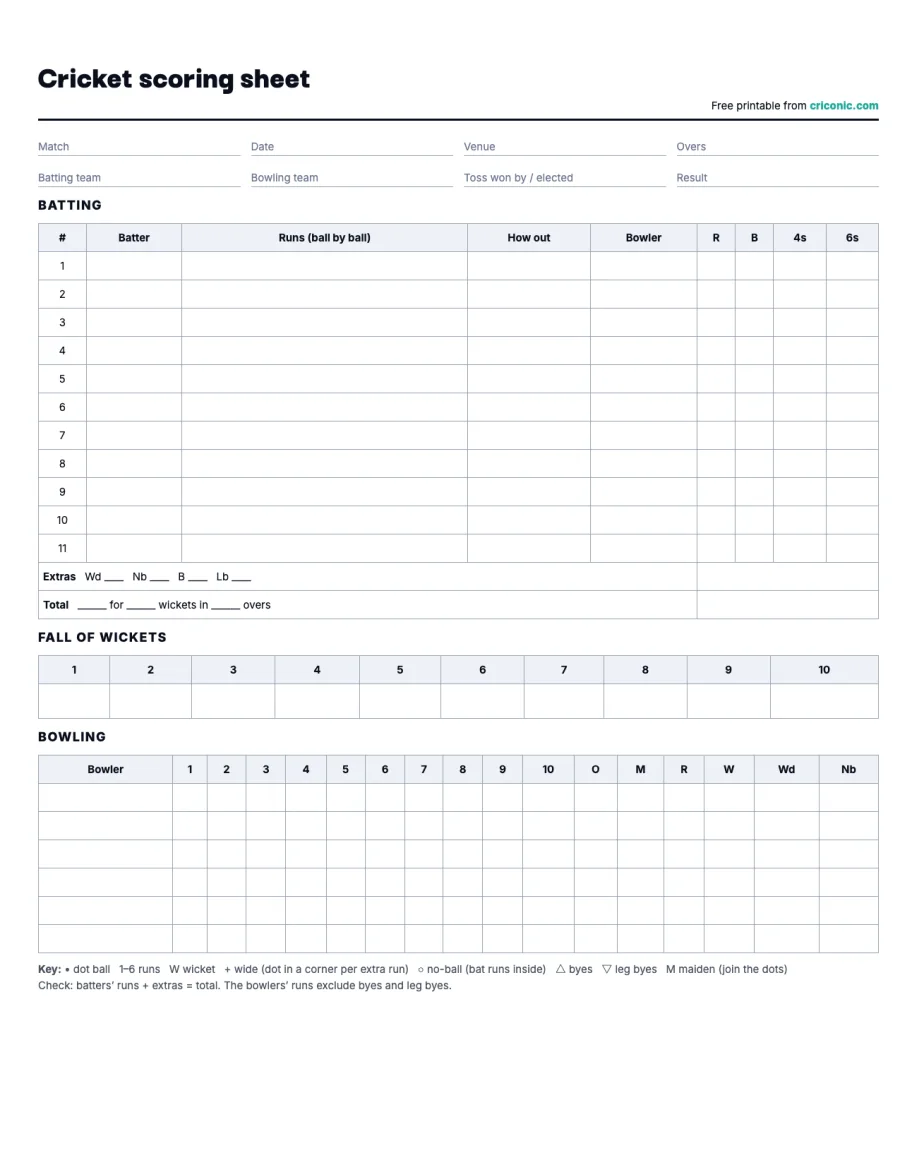
Every scorebook, paper or digital, has the same five parts for each innings:
- Match details: the teams, date, venue, overs a side, and who won the toss and chose what.
- Batting: one line per batter, in batting order. You write every run they score, ball by ball, then how they were out, the bowler, and their totals of runs, balls, fours and sixes.
- Extras and total: wides, no-balls, byes and leg byes, then the total for wickets in overs.
- Fall of wickets: the team score each time a wicket fell.
- Bowling: one line per bowler with a box for each over, then overs, maidens, runs and wickets.
Scorebook symbols
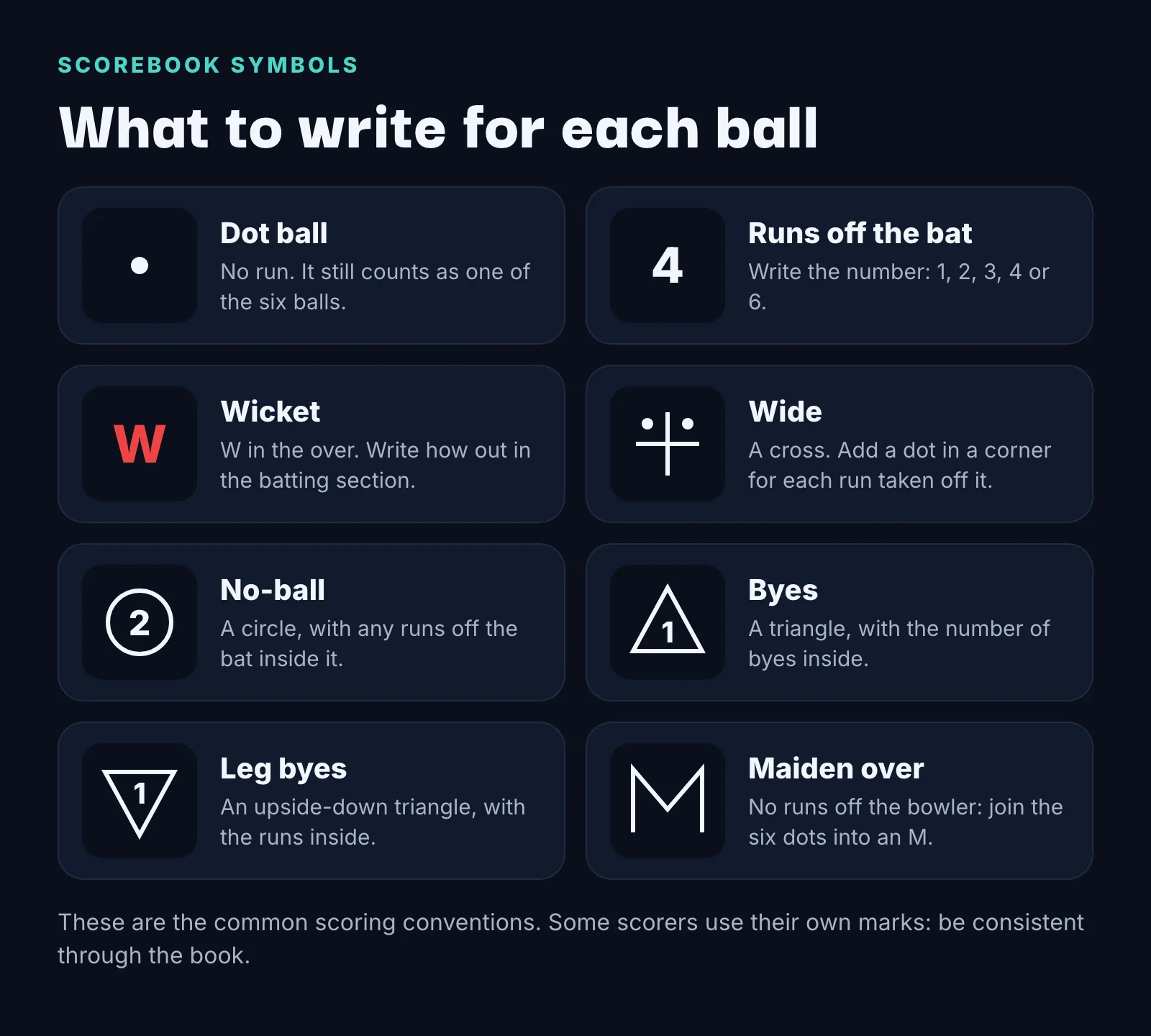
Scorers use a small set of marks so that each ball fits in a box. These are the common conventions. Some scorers have their own, which is fine as long as you use the same marks all the way through.
How to record each ball
For every delivery, you make up to three entries:
- In the bowler's over box: the mark for the ball, from the symbols above.
- In the batter's line: any runs they hit off the bat. A dot ball faced is usually left out of the runs, but count it in their balls faced.
- In the extras: any wides, no-balls, byes or leg byes.
Then work out who is on strike. The batters swap ends after an odd number of runs (1, 3 or 5) and at the end of every over.
An example over
A bowler's over goes: dot, 1, 4, wide, 2, dot, wicket (bowled). The wide was bowled again, so the over had seven deliveries but six legal balls. In the over box you write • 1 4 + 2 • W. The bowler's figures for the over are 0 maidens, 8 runs (7 off the bat plus 1 wide) and 1 wicket.
How to score extras
Extras are where most scoring mistakes happen. This is how each one works under the Laws of Cricket:
| Extra | Runs | One of the six? | Ball faced? | Against the bowler? |
|---|---|---|---|---|
| Wide | 1, plus any runs taken | No, bowl again | No | Yes |
| No-ball | 1, plus runs off the bat to the batter | No, bowl again | Yes | Yes |
| Bye | The runs taken | Yes | Yes | No |
| Leg bye | The runs taken | Yes | Yes | No |
- Wide: all the runs from a wide are wides, even if the batters run.
- No-ball: runs hit off the bat go to the batter. If the batters run without hitting it, those runs are scored as no-balls too.
- Byes and leg byes don't count against the bowler, and they don't stop an over being a maiden.
Local matches often change these. Some give no run for a wide, or no run for a no-ball. Agree it before the match, and see our wide and no-ball rules for the details.
End of an over, and wickets
At the end of each over
- Total the runs against the bowler for that over.
- If no runs came off the bowler, it's a maiden: join the six dots into an M.
- Write the team score at the end of the over, so you can find a mistake quickly later.
- The batters swap ends, and a different bowler starts the next over.
When a wicket falls
- Write W in the bowler's over box (run outs are not credited to the bowler, so mark them differently).
- In the batter's line, write how they were out, and the bowler where it counts.
- In the fall of wickets, write the team score and which batter was out.
Check your totals
At the end of each innings, the book should add up two ways:
- Batting check: all the batters' runs + all the extras = the team total.
- Bowling check: all the bowlers' runs conceded + byes + leg byes = the team total.
If either check fails, compare your end-of-over totals with the other team's scorer and find the first over where you disagree.
Common scoring mistakes
- Counting a wide or no-ball as one of the six balls of the over.
- Giving byes or leg byes to the batter, or charging them to the bowler.
- Forgetting to swap the strike after a single or at the end of the over.
- Writing overs as decimals: 10.3 overs is 10 overs and 3 balls, not ten and three-tenths.
- Not writing the score at the end of each over, which makes mistakes hard to find.
Score on your phone instead
Paper scoring is a great skill, but a phone does the maths for you. On Criconic you tap one button per ball: 0 to 6, WD, NB, BYE, LB or OUT. Strike changes, over changes, extras, run rates and the bowling figures are all worked out as you go, and the scorecard is live for anyone with the link.
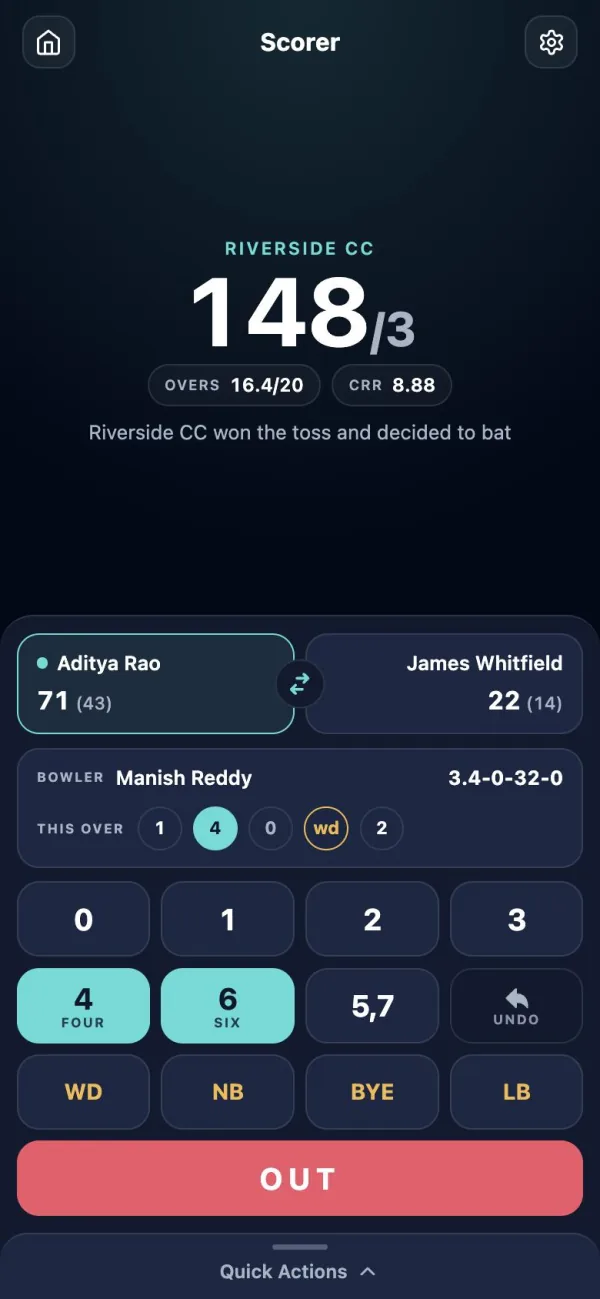
You can fix a mistake with UNDO, and the batting card, bowling figures and fall of wickets fill in by themselves. Scoring, scorecards and stats are free. Follow the step-by-step cricket scorecard tutorial to score your first match.
Questions
How do you score a cricket match?
For every ball, write a mark in the bowler's over box, add any runs off the bat to the batter, and note any extras. Swap the strike after odd runs and at the end of each over, and check that batters' runs plus extras equal the total.
What are the symbols in a cricket scorebook?
A dot for a dot ball, the number for runs, W for a wicket, a cross for a wide, a circle for a no-ball, a triangle for byes and an upside-down triangle for leg byes. A maiden over is marked by joining its six dots into an M.
Is a wide counted against the bowler?
Yes. Wides and no-balls count against the bowler. Byes and leg byes don't.
Does a no-ball count as a ball faced?
Yes. A no-ball counts as a ball faced by the batter, but not as one of the six balls of the over. A wide counts as neither.
Where can I get a cricket scoring sheet?
Download Criconic's free printable scoring sheet: one innings on an A4 page, with batting, extras, fall of wickets and bowling sections.