
How to Organise a Cricket Tournament: Formats, Fixtures and Points Table
Organize a local cricket tournament: pick a format, work out how many matches you need, write a rules sheet, and keep the points table and NRR right.
A local cricket tournament looks simple from the outside: book a ground, invite some teams, hand out a trophy. Then the results start coming in, three captains message you about net run rate, and the final starts an hour late.
This guide walks through organizing a local tournament from the first idea to the final: picking a format, working out how many matches you need, writing the rules sheet, and keeping the points table right without a spreadsheet.
Tournament checklist
Settle these before you invite a single team:
- Number of teams, and the format (league, groups, knockout)
- Overs a match, ball type and the playing rules
- Ground, dates and how many matches fit in a day
- Entry fee, prize money and what the fee covers (ground, balls, umpires, trophies)
- Umpires and scorers for every match
- Squad size, registration deadline and player eligibility
- Points system and tie-breakers
- What happens with rain, bad light or a team that doesn't turn up
- How teams and fans will follow scores and standings
Choose a tournament format
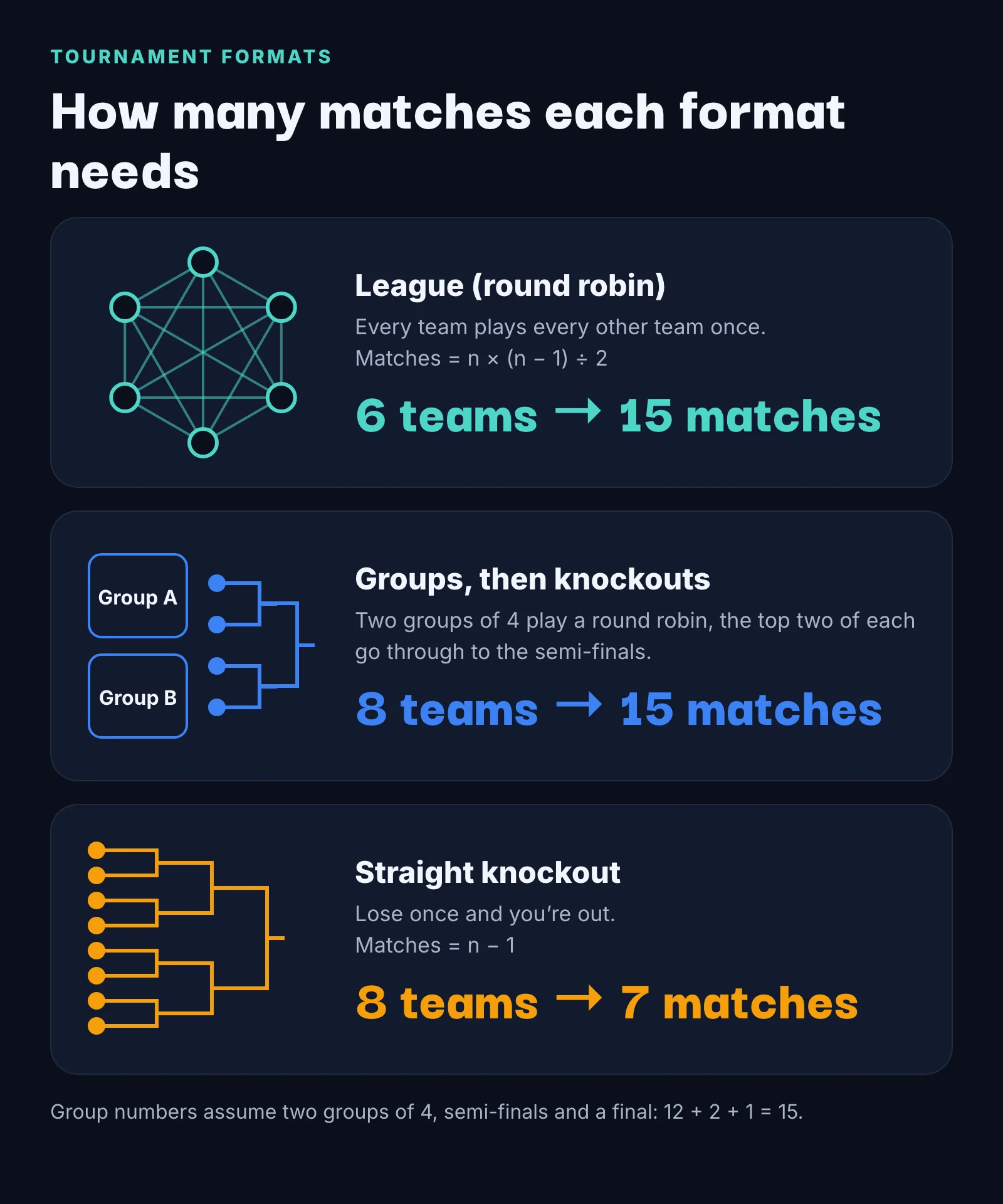
The format decides how many matches you need, so choose it before you book the ground. These are the three formats most local tournaments use:
League (round robin)
Every team plays every other team once, and the top of the points table wins, or goes through to a final. It is the fairest format, because one bad day doesn't knock a team out, but it needs the most matches.
Groups, then knockouts
Split the teams into groups, play a round robin inside each group, and send the top one or two from each group to semi-finals or quarter-finals. It is the best balance for 8 to 16 teams.
Straight knockout
Lose once and you're out. It needs the fewest matches and suits one-day and night tournaments with many teams, but half the teams play only once, so entry fees feel steep.
How many matches will you need?
A round robin of n teams needs n × (n − 1) ÷ 2 matches. A knockout needs n − 1, because every match but the final knocks out one team.
| Teams | Round robin | Two groups + semis + final | Knockout |
|---|---|---|---|
| 4 | 6 | Not needed | 3 |
| 6 | 15 | 6 + 3 = 9 | 5 (with 2 byes) |
| 8 | 28 | 12 + 3 = 15 | 7 |
| 10 | 45 | 20 + 3 = 23 | 9 (with byes) |
| 12 | 66 | 30 + 3 = 33 | 11 (with byes) |
When the number of teams isn't a power of two (4, 8, 16), a knockout needs byes: some teams skip the first round so that the next round is even.
Write a rules sheet
Nearly every tournament dispute is about a rule nobody wrote down. Share a one-page rules sheet with every captain at registration, and print it on the day. It should cover:
- Playing rules: overs, players a side, overs per bowler, ball type, wides, no-balls, free hit, LBW and bouncers. For tennis ball and turf events, borrow from our tennis ball cricket rules and box cricket rules checklists.
- Squads: squad size, the registration deadline, whether a player can play for two teams, and whether squads can change mid-tournament.
- Timing: reporting time, what counts as a walkover, and the penalty for bowling overs slowly.
- Points and tie-breakers: points for a win, tie and no result, and how teams level on points are separated.
- Weather: how a shortened match is decided, and what happens to a washed-out match.
- Disputes: who has the final word. Usually it's the organizer, after hearing the umpires.
Points table and tie-breakers
The most common system is 2 points for a win, 1 for a tie or no result, and 0 for a loss. Teams level on points are usually separated by net run rate (NRR): runs scored per over minus runs conceded per over, across all league matches.
NRR causes more arguments than anything else in local cricket, because two details are easy to get wrong:
- Overs are counted in balls. 10.3 overs is 10.5 overs in the maths, not 10.3.
- A team bowled out counts its full quota. A side all out in 7.2 overs of a 10-over match is treated as having faced 10 overs.
Other tie-breakers you can list after NRR: more wins, then the result of the match between the two teams. Write the order down before the first match. Changing it once a team is about to miss out never ends well.
Running the matches
- One scorer per match, agreed in advance. Two teams keeping separate scorebooks and comparing them at the end is a recipe for an argument.
- Neutral umpires wherever you can. If teams umpire each other, rotate so that no team umpires its own group rivals.
- Spare balls of the agreed brand, and a rule for when the ball gets changed.
- Results the same day. Post each result and the updated table straight after the match, not at the end of the week.
- Awards: decide in advance how player of the match and the tournament awards are picked, so the top run-scorer and wicket-taker come from the scorecards rather than memory.
Run your tournament on Criconic
Criconic keeps the scorecards, the points table and the leaderboards in one place:
- Create the tournament with its name, location, dates, ball type, banner, logo and rules, picked from a ready-made list or written yourself.
- Bring in the teams yourself, or share the tournament QR code so captains join by scanning it. Players join their team with the team's QR code.
- Make the fixtures in a few taps in the app: a league, groups + knockout, or a straight knockout, with the days and times, and the knockouts fill in as results come in. Or add each match yourself and label its round: league, quarter-final, qualifier, eliminator, final, or your own name.
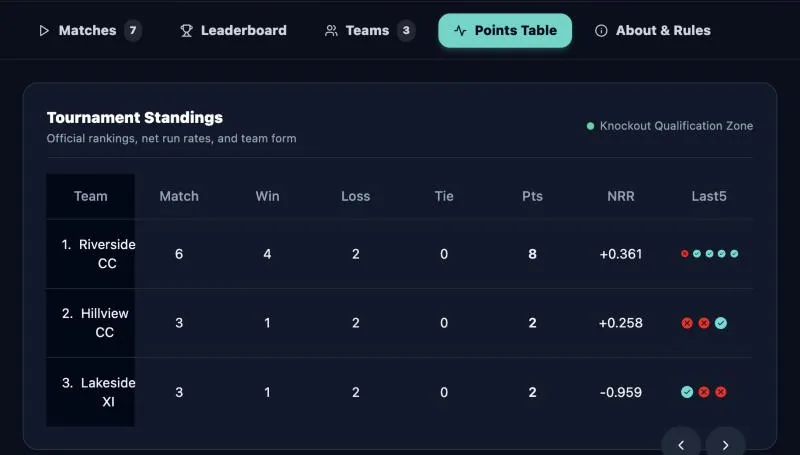
- The points table updates itself after every league match: 2 points for a win, 1 for a tie, sorted by points and then net run rate. Knockout matches don't change it.
- Batting and bowling leaderboards for the tournament awards, plus career stats for every player. Scoring, scorecards and stats are free.
- One public page with live, upcoming and finished matches and the standings, so nobody has to ask in the group who's through. Make the tournament private if you prefer.
- Organizers can score any match in the tournament, and you can stream every match with a live scoreboard overlay from one link.
Step by step, with screenshots: how to create a cricket tournament online. Or see everything on the cricket tournament app page, or create your tournament now.
Questions
How many matches are there in a round robin tournament?
n × (n − 1) ÷ 2, where n is the number of teams. 6 teams need 15 matches, 8 teams need 28 and 10 teams need 45.
What is the best format for an 8-team cricket tournament?
Two groups of four, then semi-finals and a final. That is 15 matches in all, and every team plays at least three.
How many points for a win in a cricket tournament?
Most local tournaments give 2 points for a win, 1 for a tie or no result and 0 for a loss. Teams level on points are separated by net run rate.
How is net run rate calculated in a tournament?
Total runs scored divided by total overs faced, minus total runs conceded divided by total overs bowled. Overs are counted in balls, and a team bowled out is counted as facing its full overs.
What should a cricket tournament rules sheet include?
Playing rules (overs, bowlers, extras, LBW), squad rules, reporting times and walkovers, points and tie-breakers, weather rules and who settles disputes.