
Tennis Ball Cricket Rules: Tournament, Tape Ball and Gully Rules
Tennis ball cricket rules for local tournaments: overs, bowler limits, bouncers, LBW and wides, plus tape ball, ISPL and gully cricket rules.
Most cricket in India isn't played with a leather ball. It's played with a tennis ball on a cement strip, a matting wicket or a patch of open ground: in the gully after school, in Sunday tournaments and in night tournaments under floodlights that run past midnight.
Tennis ball cricket follows the Laws of Cricket loosely and changes the rest. There is no national rulebook, so every organizer prints their own. This guide covers the rules most tennis ball tournaments use, how tape ball cricket differs, the gully rules everyone grows up with, and a checklist to settle before the toss.
Tennis ball cricket rules at a glance
What a typical local tennis ball tournament looks like, unless the organizer says otherwise:
| Rule | What most tournaments do |
|---|---|
| Players | 8 to 11 a side, with the innings ending one wicket before the team runs out |
| Overs | 6 to 10 overs an innings. T10 is the most common |
| Bowlers | Usually 2 overs each at most, sometimes 3 in the semi-final and final |
| Bowling action | Overarm. A bowler called for throwing gets warnings, then a ban |
| Bouncers | One an over. A bouncer over the batter's head is a wide |
| LBW | Not given |
| Leg byes | Only when the batter tried to play a shot |
| Wide or no-ball | 1 run and an extra ball |
| Last batter | Usually can't bat alone |
| Tie | Super over |
How tennis ball cricket differs
A tennis ball is light and soft, so nobody needs pads, a helmet or gloves, and anyone can play. That changes the game in a few ways:
- It bounces high and skids. On cement or matting the ball comes on quickly, so short-pitched bowling is easy to overdo, which is why tournaments limit bouncers.
- It barely spins or seams. Bowlers rely on pace, yorkers and changes of length. A slower ball is the main variation.
- It travels. A clean hit with a heavy bat goes a long way, so grounds are small and sixes are common.
- LBW doesn't work. With a bouncy ball and no neutral umpire, LBW would start an argument every over, so almost every tournament leaves it out.
Teams, overs and bowler limits
Players a side
Full tournaments still play 11 a side, but 8-a-side is common for shorter games and night tournaments. The innings ends when the team runs out of partners: at the 10th wicket with 11 players, or at the 7th wicket with 8. Squads are usually submitted before the tournament, and a player can turn out for only one team.
How many overs?
T10 (10 overs an innings) is the standard for tennis ball tournaments, and the format the Indian Street Premier League (ISPL) plays. Night tournaments with many teams often play 6 or 8 overs to fit every match into one evening, with longer finals.
Overs per bowler
A common cap is 2 overs per bowler in a 10-over game, which means at least five bowlers. Some tournaments let one bowler bowl 3 overs in the semi-final and final. In 6-over matches the cap is often a single over each.
Bowling rules: action, bouncers and wides
Overarm, and no throwing
Tournament tennis ball cricket is bowled overarm. Throwing is the most common complaint, because a bent-arm delivery is very quick with a tennis ball. Organizers usually let the umpire call a throw as a no-ball, warn the bowler and captain, and stop a bowler from bowling after repeated calls.
Bouncers
A common rule is one bouncer an over. A second bouncer in the same over is a no-ball, and a bouncer that goes over the batter's head is a wide.
Wides
Tennis ball umpires call wides strictly, especially down the leg side, because batters can't do much with a ball that is going away from them. Many tournaments mark wide lines on the pitch so the call isn't a guess.
Fielding restrictions
Some tournaments require a minimum number of fielders on each side of the pitch, so a team can't pack the leg side for a batter who only hits one way. Breaking the rule makes the ball a no-ball.
LBW, dismissals and extras
- LBW is not given. Bowled, caught, run out, stumped and hit wicket all count as normal.
- Leg byes usually count only when the batter tried to play a shot. Otherwise the ball is dead and no runs count.
- Wides and no-balls give the batting side 1 run and an extra ball. Some tournaments give a free hit after a no-ball. Many don't, so check.
- The last batter usually can't carry on alone in tournaments. Gully games often allow it (see below).
- Ties are settled with a super over in most tournaments, and the batting side's super over usually ends early if it loses two wickets. See the full super over rules.
Tape ball cricket rules
A tape ball is a tennis ball wrapped tightly in electrical tape. It started in the streets of Karachi and spread across South Asia and to wherever its players moved. The tape gives the ball a smooth, heavier surface, so it:
- comes off the pitch noticeably quicker than a plain tennis ball
- swings late, and reverse swings once one side wears
- hardly spins, so pace and yorkers rule
- still needs no pads or helmet, though it stings more
How tape ball rules differ
The rules are mostly the same as tennis ball cricket. These are the points to agree on:
- How the ball is taped. Fully wrapped, or one half taped to help it swing. Agree the tape and the ball before the match, and keep spares, because tape tears on rough ground.
- Bowling action. Some tape ball leagues ban overarm and allow only round-arm bowling, kept below shoulder height, because a taped ball bowled overarm is very fast.
- Bats. Some leagues ban fibre and other non-wooden bats.
Organized versions keep the same spirit. The ECB's tapeball format in England, for example, plays short games with no LBW and retires batters at 30 runs so everyone bats.
ISPL rules: tape ball overs and the 50-50 challenge
The Indian Street Premier League, a professional T10 tennis ball league started in 2024, added a few rules of its own that people now ask about:
- Tape ball overs: two overs in each innings are bowled with a tape ball instead of a tennis ball.
- The 50-50 challenge: once an innings, the batting side predicts how many runs it will score in the next over (16 or more) and picks one of the bowlers the fielding side offers. Hit the target and the over counts for 150% of the runs scored. Miss it and it counts for 50%.
- Bonus sixes: a six that lands in the crowd is worth 9 runs.
- The tip-top toss: the captains walk heel to toe towards each other, and the one who steps on the other's foot wins the toss.
Gully cricket rules
Street and gully cricket keep the tennis ball and drop the umpire. The rules change from lane to lane, but most players know these:
- One tip, one hand: a one-handed catch after a single bounce is out.
- Hit a window or over the wall, you're out: whoever hits it into a house or over a wall is out, and often has to fetch the ball as well.
- One side only: when one side of the lane is a wall or a row of cars, shots on that side score nothing, or get you out.
- Last man batting: the last batter carries on alone and must run every run.
- Wall as wicketkeeper: a ball that hits the wall behind the stumps on the full can count as caught.
- A trial ball before the first over, and no LBW, ever.
Agree these rules before the toss
Most tennis ball arguments are about rules nobody said out loud. Before a tournament, print these on the rules sheet. Before a friendly, settle them in the team group.
- Players a side, and the wicket at which the innings ends
- Overs an innings, and the most overs one bowler can bowl
- Tennis ball or tape ball, which brand, and when the ball gets changed
- Overarm or round-arm, and how a throw is called
- Bouncers allowed an over, and what happens to one over the head
- Where the wide lines are
- Whether LBW is given, and when leg byes count
- Runs for a wide and a no-ball, and whether there is a free hit
- Whether the last batter can bat alone
- Fielding restrictions, if any
- How a tie is settled
- Points for a win and a tie, and how teams level on points are separated
How to score a tennis ball match
Tennis ball matches deserve a proper scorecard too. Criconic is set up for them from the start:
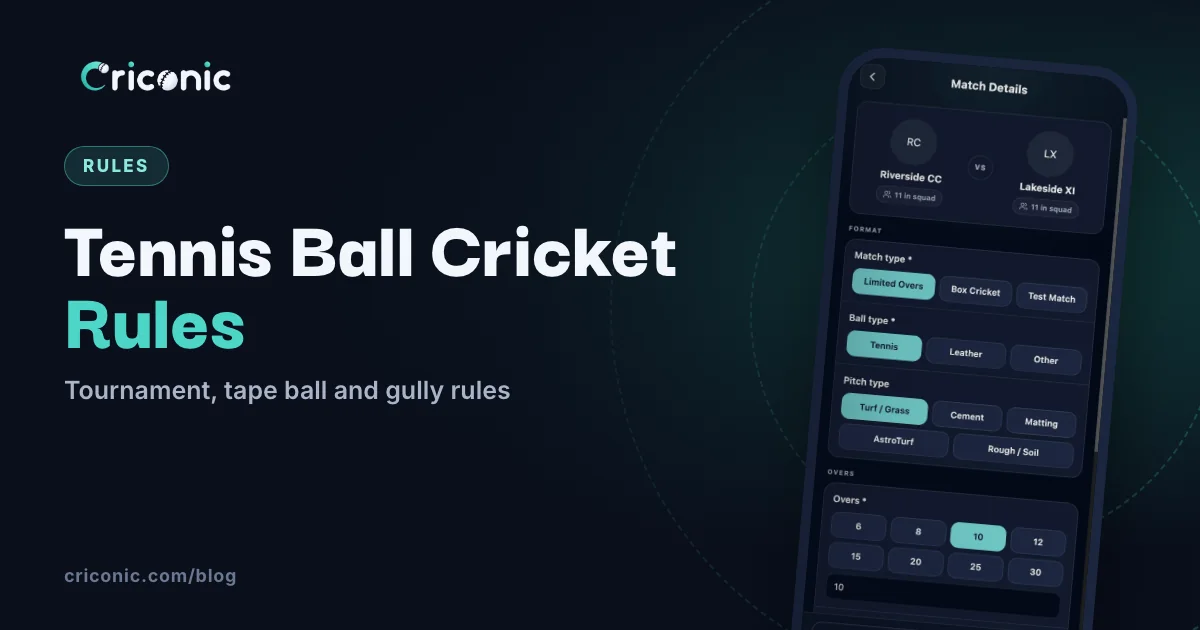
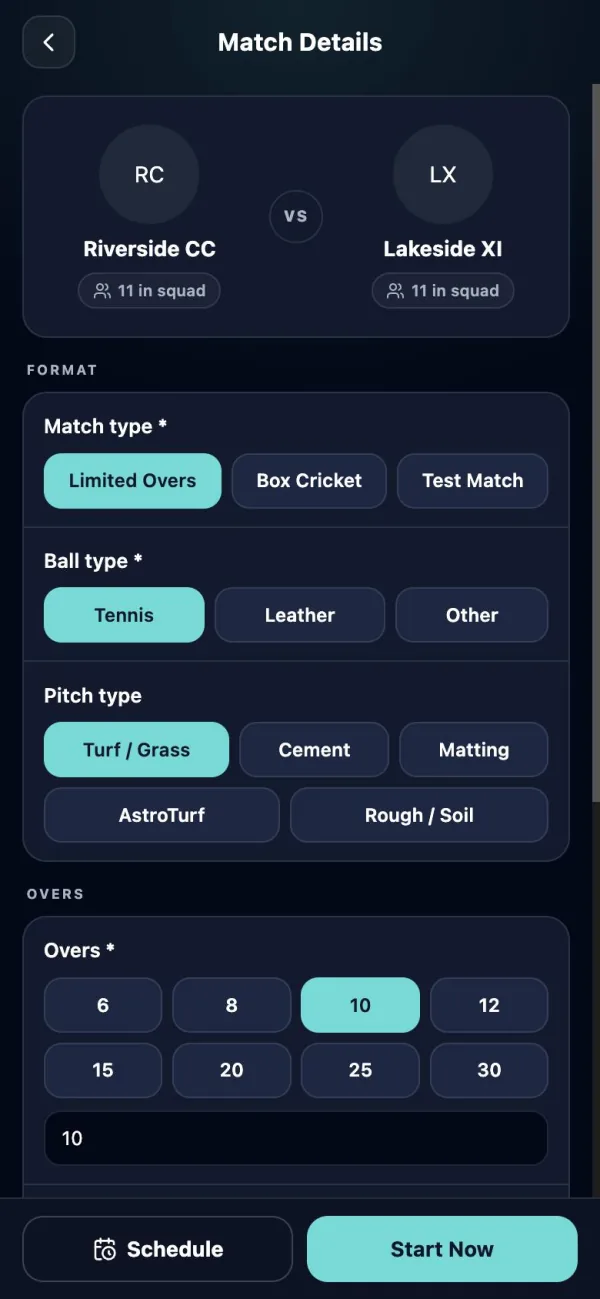
- Tennis ball is the default ball type, and you can choose a cement, matting, turf, AstroTurf or rough pitch.
- Your local rules: any number of overs with an optional power play, whether wide and no-ball runs count, last man stands, and bonus or penalty runs for either side.
- Whoever turns up: create a team on the spot, add or remove players mid-match, and bring on a substitute.
- Super overs when the scores finish level.
- A wagon wheel and pitch map on every scorecard, and career stats for every player. Scoring, scorecards and stats are free.
- A live link for the group, and a TV-style scoreboard overlay if you stream the match.

Running a night tournament? The tournament app keeps the points table and leaderboards for you. Playing on a turf instead? See our box cricket rules. Or go straight to the tennis ball cricket scoring app.
Questions
Is LBW out in tennis ball cricket?
Almost never. Most tennis ball tournaments and gully games don't give LBW. Bowled, caught, run out, stumped and hit wicket still count.
How many overs can a bowler bowl in tennis ball cricket?
In a 10-over match the usual limit is 2 overs per bowler, sometimes 3 in the semi-final and final. In 6-over matches it is often 1 over each.
Are bouncers allowed in tennis ball cricket?
Usually one an over. A second bouncer in the over is a no-ball, and a bouncer over the batter's head is a wide.
What is a tape ball?
A tennis ball wrapped tightly in electrical tape. It comes off the pitch faster than a plain tennis ball and swings late, but still needs no pads or helmet. It started in Karachi.
What is the one tip one hand rule?
A gully cricket rule: if a fielder catches the ball one-handed after it bounces once, the batter is out.
What is the 50-50 challenge in ISPL?
Once an innings, the batting side predicts its runs for the next over (at least 16) and picks the bowler from options the fielding side gives. Reach the target and the over counts for 150% of the runs. Miss it and it counts for 50%.