
Single Wicket Cricket Rules: How One-on-One Cricket Works
Single wicket cricket rules: one player against another, overs, getting out, ties and fielders, plus how to run and score a single wicket tournament.
Single wicket is cricket at its most personal: one player against another. You bat, you bowl, and there's nobody else to blame. It is perfect for settling an argument after nets, a practice-night competition or a fundraiser where everyone gets a turn.
There is no official rulebook, so here is the common format, the variations to agree before you start, and how to run a single wicket tournament.
Single wicket rules
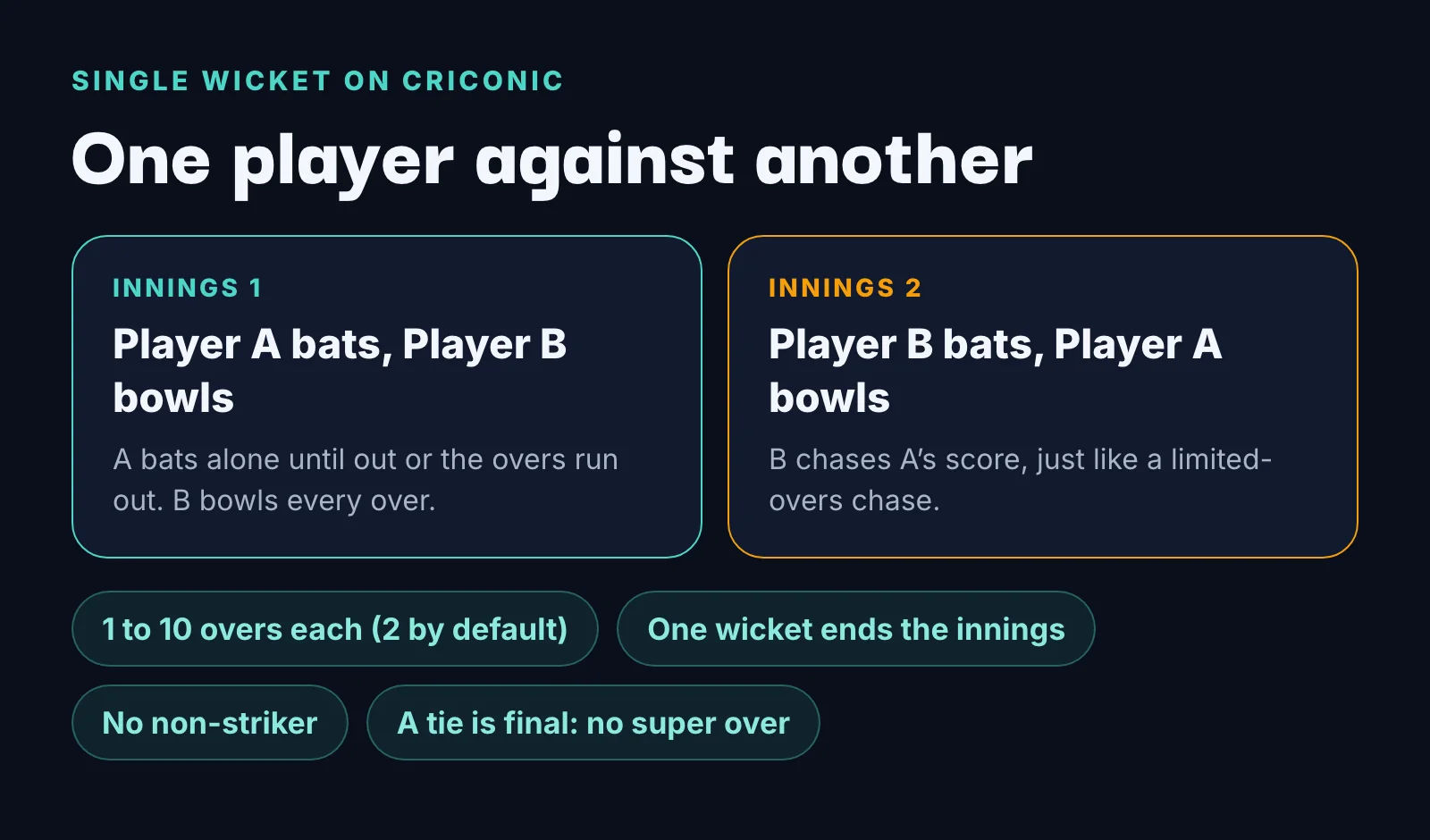
- Two players, two innings. Player A bats while Player B bowls, then they swap and B chases A's score.
- A few overs each. Usually 1 to 3 overs a player, so a contest takes minutes.
- The bowler bowls every over of the other player's innings.
- One wicket ends the innings. Get out, and your score is what you have.
- No partner. There is no non-striker, so the batter faces every ball.
- Highest score wins.
Variations to agree before you start
- Out, but carry on: some contests let a batter keep batting after a dismissal and take a fixed number of runs off their score for each wicket instead of ending the innings.
- Fielders: formal contests may give both players the same fielders. Casual games leave the bowler to field alone, which makes running between the wickets easier.
- LBW: usually not given, especially without a neutral umpire.
- Wides and no-balls: usually 1 run and the ball is bowled again, like any other match.
- Ties: decide in advance. A bowl-out or a one-ball shootout works if you need a winner.
How to run a single wicket tournament
- Pick a format. A straight knockout is quickest: 8 players need 7 contests, 16 need 15. Groups of three or four make sure everyone plays more than once.
- Keep contests short. One or two overs each lets you fit a 16-player knockout into an evening.
- Decide the tie rule and the variations above before the first contest.
- Toss for who bats first in each contest, or let the higher seed choose.
- Score every contest so the results and the bracket are never in dispute.
The match counts work like any other knockout. See how to organise a cricket tournament for the maths.
Score a single wicket match on Criconic
Criconic has a Single Wicket match type built for one-on-one contests:
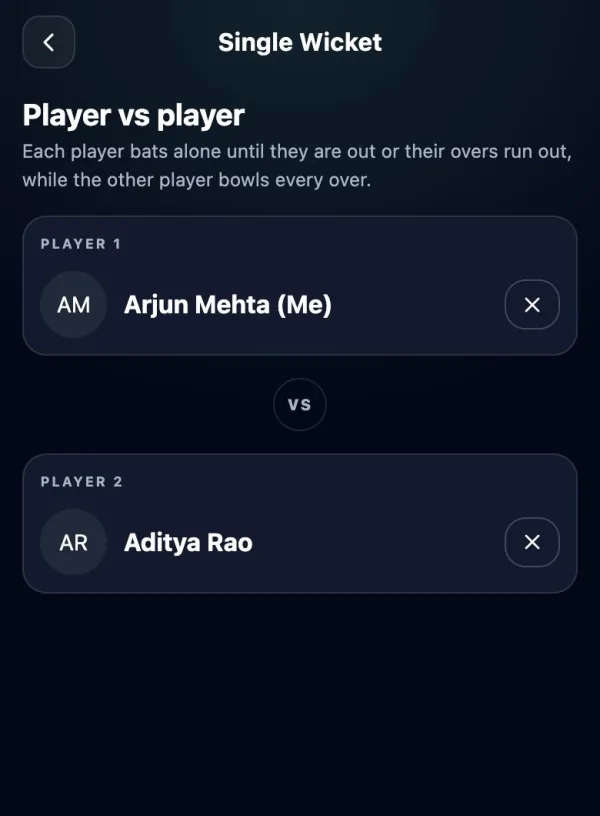
- Start a new match and choose Single Wicket (player vs player, no teams needed).
- Pick the two players. Tap It's me to add yourself.
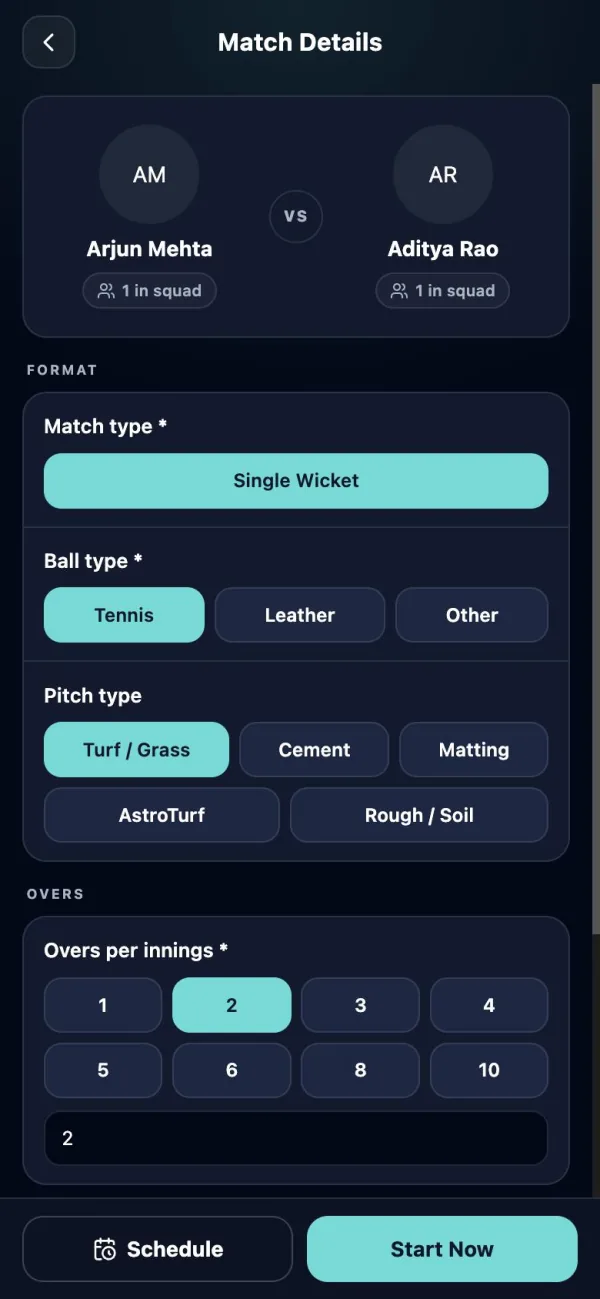
- Set the overs per innings, from 1 to 10 (2 by default), the ball and the pitch, then do the toss.
- Score it ball by ball. The batter bats alone, and the same bowler bowls every over.
What the app does for you
- One wicket ends the innings, and the second player's innings is a chase with a target.
- A tie is final: there is no super over in single wicket.
- Every ball gets the same scorecard, commentary and analysis as a team match.
Questions
What is single wicket cricket?
A one-on-one form of cricket: two players each bat and bowl, usually for one to three overs, and the higher score wins.
How many overs are there in single wicket?
Usually 1 to 3 overs per player. On Criconic you can set 1 to 10 overs per innings, with 2 as the default.
What happens when you get out in single wicket?
In the common format, one wicket ends your innings. Some contests let a batter carry on with a fixed number of runs taken off their score for each wicket.
Is there a super over in single wicket?
Not on Criconic: a tied single wicket match stays a tie. If your contest needs a winner, agree a bowl-out or a one-ball shootout beforehand.
How do you organise a single wicket tournament?
Use a knockout bracket or small groups, keep contests to one or two overs each, agree the tie rule in advance, and score every contest so results aren't disputed.