
Super Over Rules in Cricket: Who Bats First, Wickets and Ties
Super over rules explained: one over each, three batters and two wickets, who bats first, what happens if the super over is tied, and how local leagues play it.
When a limited-overs match ends with the scores level, a super over settles it: one over each, as much tension as a whole innings packed into six balls. It decided the 2019 World Cup final, and it is the standard tie-breaker in T20 cricket from the IPL to local leagues.
Here are the official rules, what happens when a super over is tied too, and how local leagues usually play it.
Super over rules
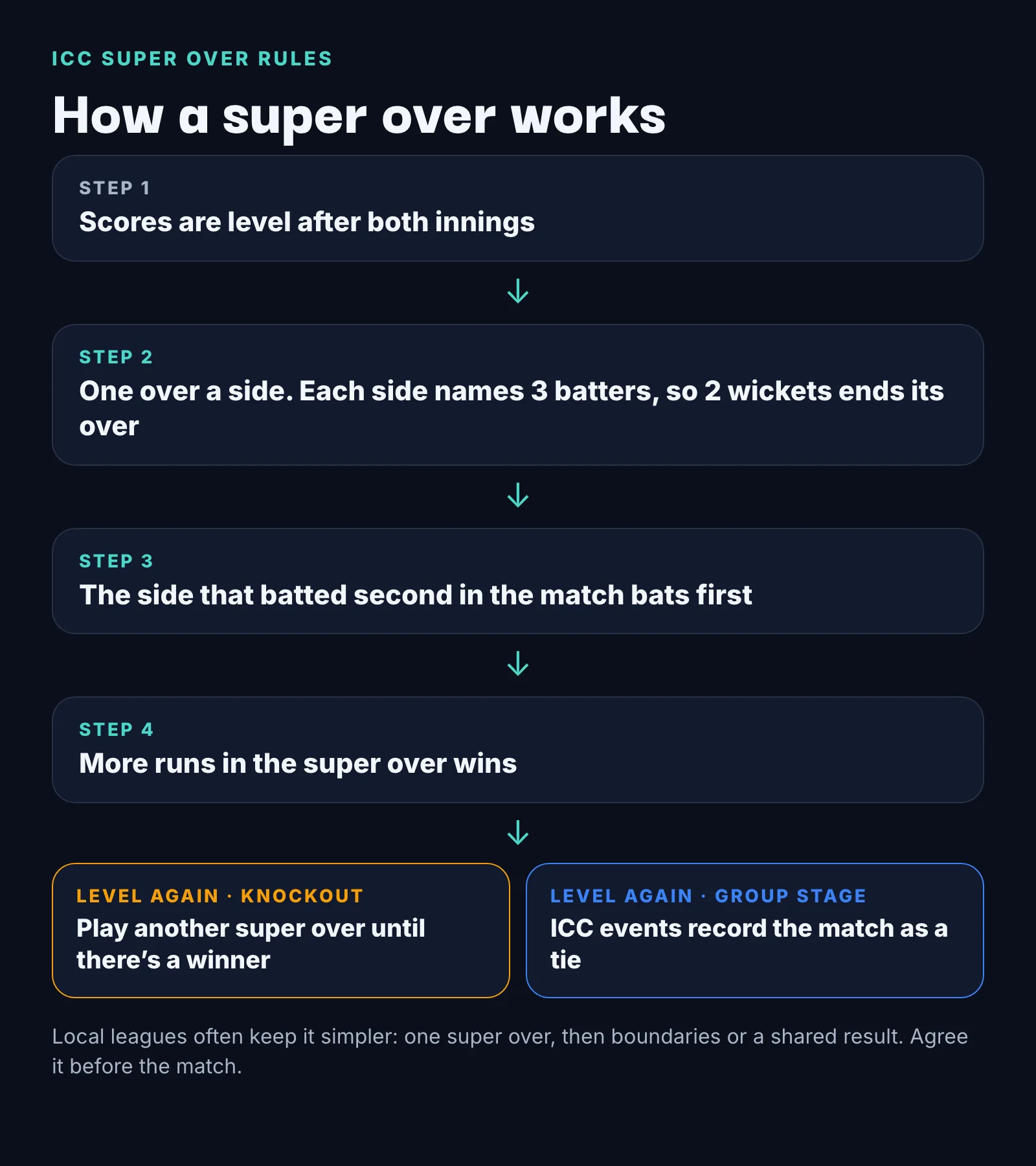
- One over each. Each side bats one over of six legal balls.
- Three batters, two wickets. Each side names three batters, so its over ends early if it loses two wickets.
- The side that batted second in the match bats first in the super over.
- The fielding side picks the end it bowls from.
- One bowler bowls the whole over, as in any other over.
- More runs wins. Wides, no-balls and other extras count, just as in the main match.
What if the super over is tied?
Since October 2019, the ICC plays it this way:
- Knockout matches: another super over, and another, until there is a winner. Each one starts a few minutes after the last.
- Group-stage matches in ICC events: the match is recorded as a tie.
Rules for the next super over
- The side that batted second in the last super over bats first in the next one.
- Any batter dismissed in an earlier super over can't bat again.
- The bowler of the previous super over can't bowl the next one.
Super overs in local cricket
Local leagues often keep it simpler, because the ground is booked and the light is going. Common versions:
- One super over only, and if that's tied, the match is a tie with points shared.
- One super over, then the side with more boundaries in the match wins.
- No super over in league matches, only in knockouts.
Write your choice on the rules sheet before the tournament starts. See how to organise a cricket tournament for what else to put on it.
Scoring a super over on Criconic
When the scores finish level in a limited-overs or box cricket match on Criconic, the scorer screen shows Match Tied with two choices: Start Super Over or Declare Tied. The super over is scored ball by ball like the rest of the match, and the scorer screen shows the runs still needed.
Single-wicket matches are the exception: a tie there is final. Learn more in our single wicket cricket rules.
Questions
What is a super over in cricket?
A one-over-each eliminator used to decide a tied limited-overs match. Each side bats one over with three batters, and the side scoring more runs wins.
Who bats first in a super over?
The side that batted second in the main match. In a repeated super over, the side that batted second in the previous super over bats first.
How many wickets are there in a super over?
Two. Each side names three batters, so its super over ends when two are out.
What happens if a super over is tied?
Under ICC rules since October 2019, knockout matches go to another super over until there is a winner. In ICC group stages, the match is a tie. The old boundary count rule is no longer used.
Can the same bowler bowl the next super over?
No. The bowler of the previous super over can't bowl the next one, and batters dismissed in an earlier super over can't bat again.